I had a dog that used to eat his own shit. And that of other dogs. Not in the least bit sane. He was finally broken of that habit but it was pretty friggin' gross.
...and dogs lick their own genitals...but given the ability...who knows??
Dog I wish you would write a book, lol, you never fail to deliver.
It's so true though, who was the first to try this? I think this about a lot of things. like who is the first person to try and eat a blowfish for it's non-poisonous parts? Who grabbed the first bud and smoked it? Who was charged with testing berries to see which ones would kill you? lol. Humanity is a weird thing.
My dog ate a sock once and shat it out a day later fully intact
I'll start the bidding at $300
Really, if you stop and think about it this story reflects three of the most phenomenal moments in human history.
1. first somebody had to be the first guy to try this? I mean think about it……....somebody had to say……....hey, there are some beans in this shit...........I know..........I'll brew it up and drink it.
2. Next, somebody had to then say..............hey…......I know…....we can sell this shit to American and Japanese dumb asses for 5000 times more money than they pay for non- defecated coffee……………
3. Somebody actually bought the first bag
And that my friend is the story of humanity in three points. Not the discovery of fire, the wheel, or a man on the moon………….. but 227 dollar shit in a bag that somebody actually tried and others are actually willing to buy.
SAGADA, the Philippines — Goad Sibayan went prospecting recently in the remote Philippine highlands here known as the Cordillera. He clambered up and then down a narrow, rocky footpath that snaked around some hills, paying no heed to coffins that, in keeping with a local funeral tradition, hung very conspicuously from the surrounding sheer cliffs.
Reaching a valley where coffee trees were growing abundantly, he scanned the undergrowth where he knew the animals would relax after picking the most delicious coffee cherries with their claws and feasting on them with their fangs. His eyes settled on a light, brownish clump atop a rock. He held it in his right palm and, gently slipping it into a little black pouch, whispered:
“Gold!”
Not quite. But Mr. Sibayan’s prize was the equivalent in the world of rarefied coffees: dung containing the world’s most expensive coffee beans.
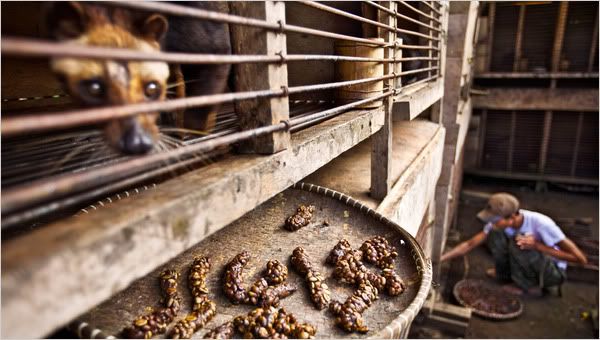
Costing hundreds of dollars a pound, these beans are found in the droppings of the civet, a nocturnal, furry, long-tailed catlike animal that prowls Southeast Asia’s coffee-growing lands for the tastiest, ripest coffee cherries. The civet eventually excretes the hard, indigestible innards of the fruit — essentially, incipient coffee beans — though only after they have been fermented in the animal’s stomach acids and enzymes to produce a brew described as smooth, chocolaty and devoid of any bitter aftertaste.
As connoisseurs in the United States, Europe and East Asia have discovered civet coffee in recent years, growing demand is fueling a gold rush in the Philippines and Indonesia, the countries with the largest civet populations. Harvesters are scouring forest floors in the Philippines, where civet coffee has emerged as a new business. In Indonesia, where the coffee has a long history, enterprising individuals are capturing civets and setting up minifarms, often in their backyards.
Neither the Indonesian government nor the Association of Indonesia Coffee Exporters breaks down civet coffee’s tiny share of Indonesia’s overall coffee production. The Association of Indonesian Coffee Luwak Farmers, created in 2009 to handle the rising demand for civet coffee, or kopi luwak, as it is called in Indonesian, said most civet producers were small-time businessmen who exported directly overseas.
Given the money at stake, fake and low-grade civet coffee beans are also flooding the market.
“Because of its increasing popularity, there is more civet coffee than ever, but I don’t trust the quality,” said Rudy Widjaja, 68, whose 131-year-old family-owned coffee store in Jakarta, Warung Tinggi, is considered Indonesia’s oldest.
Competition is touching off fierce debates. What is real civet coffee, anyway? Does the civet’s choice of beans make the coffee? Or is it the beans’ journey through the animal’s digestive tract? Can the aroma, fragrance and taste of beans from the droppings of a caged civet ever be as tasty as those from its wild cousin?
Vie Reyes, whose Manila-based company, Bote Central, entered the civet coffee business five years ago, said she bought only from harvesters of the wild kind. Ms. Reyes exports to distributors overseas — Japan and South Korea are her biggest markets — and also directly sells 2.2-pound bags for $500, or about $227 a pound.
Maintaining quality was a constant challenge because distinguishing the real stuff from the fake was never easy. One time, harvesters sold her regular beans glued to unidentified dung.
“I washed it,” she said. “But the glue wouldn’t come off.”
One of her suppliers, Mr. Sibayan, 37, buys beans from collectors throughout the Cordillera, a mountainous region in the north that can be reached only after a punishing 12-hour drive from Manila. On a recent day, he dropped by to see the Pat-ogs, who own a 1.7-acre lot just outside this town.
Until Mr. Sibayan began buying their civet coffee four years ago, the Pat-ogs had never given much thought to the droppings left behind by the civets that came to munch on the family’s coffee trees at night. They discarded the beans or mixed them with regular beans they sold to agents. Now, they were getting about $9 a pound for the civet beans, or about five times the price of regular coffee beans, which, furthermore, required labor-intensive harvesting.



 :lol:
:lol:
Leave a comment: